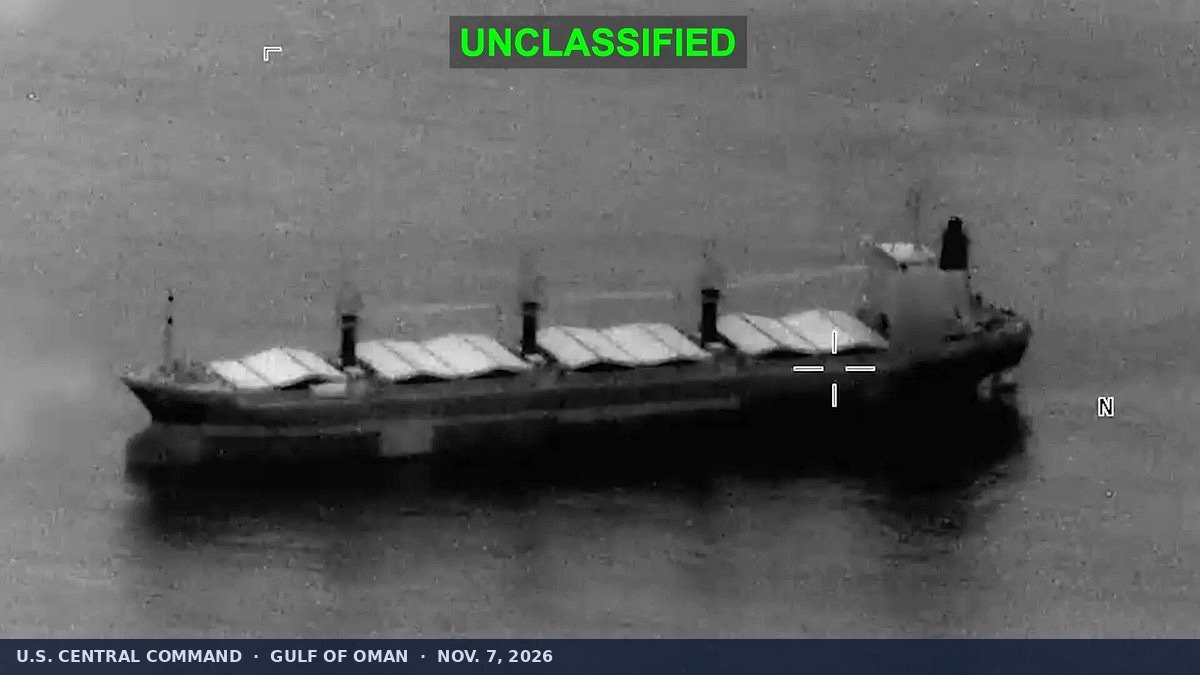
U.S. Central Command says American forces disabled the St. Kitts-flagged cargo ship M/V Huda in the Gulf of Oman on Saturday after its crew ignored repeated warnings and tried more than once to run the U.S. naval blockade of Iran.
What happened
According to a CENTCOM public release dated Nov. 7, 2026, CENTCOM forces disabled a commercial vessel in the Gulf of Oman after the ship’s civilian crew ignored repeated warnings and attempted to violate the naval blockade against Iran multiple times.
A U.S. military aircraft fired precision munitions at the stern of M/V Huda, disabling the ship after forces directed the crew to abandon targeted spaces. CENTCOM said the cargo vessel had visited an Iranian port and then tried to leave regional waters.
The naval blockade, in plain terms, is a U.S. effort to stop ships from moving sanctioned cargo—especially oil and other restricted goods—into or out of Iran by sea.
Defense Secretary Pete Hegseth amplified the CENTCOM notice on X Saturday afternoon by reposting the command’s update.
Key facts from CENTCOM
- When / where: Nov. 7, 2026, Gulf of Oman
- Ship: St. Kitts-flagged commercial cargo vessel M/V Huda
- Action: Precision munitions struck the stern after warnings and after the crew was told to clear targeted spaces
- Trigger: Multiple attempts to violate the blockade after an Iranian port call
- Mariner warning: Ships near Iranian coastal areas are advised to heed U.S. blockade warnings
Broader enforcement context
CENTCOM said enforcement since July has redirected 147 commercial vessels that complied and disabled five merchant ships that refused. The command also said it previously destroyed 10 Iranian commercial oil tankers tied to what it described as an IRGC multibillion-dollar shadow network.
Arab News, republishing Reuters, reported the Saturday disablement and noted CENTCOM’s estimate that the naval blockade has prevented more than $25 billion in Iranian crude exports. The same Saturday, CENTCOM also announced Task Force Iron Gate to pressure Iran’s land and Caspian routes—a related development HISARAK covered separately and not retreaded here.
The Associated Press also reported Saturday that the U.S. military said it fired on a commercial vessel in the Gulf of Oman after an attempted blockade breach, matching the CENTCOM account of the strike.
Iran’s posture
Tehran has threatened broad retaliation against Gulf infrastructure amid rising U.S. pressure, according to Reuters via Arab News. As of Saturday evening Eastern time, Iranian officials had not issued a detailed public response specifically addressing the disablement of M/V Huda.
Why it matters
Saturday’s action is a concrete enforcement strike—not a new strategy announcement. It shows CENTCOM is still using force against ships that refuse to turn around, even as Washington widens pressure beyond the water. For commercial mariners, the message from Tampa is blunt: ignore the warnings, and the stern can become the target.
Sources: CENTCOM public release; Arab News / Reuters; AP via CTV News; CENTCOM on X; Pete Hegseth on X.